
Methods for Building Demolition
 In order to build a new house or simply because you have some other plans for your property, sometimes it’s necessary to execute controlled demolition. The process you should choose depends greatly on the location, the building material, but also on the reasons for the demolition and how the debris should be disposed of. I’ll try to summarize four controlled demolition methods used for buildings and houses.
Implosion is a method of bursting inward violently allowing the sequential elimination of the structure supports. It is used in urban areas, especially for larger structures. In implosion, the timing and the placement of the charges are of crucial importance, because they allow the building to collapse induced by the structural weight. In order to demolish a building successfully, each structural blueprint has to be analyzed.
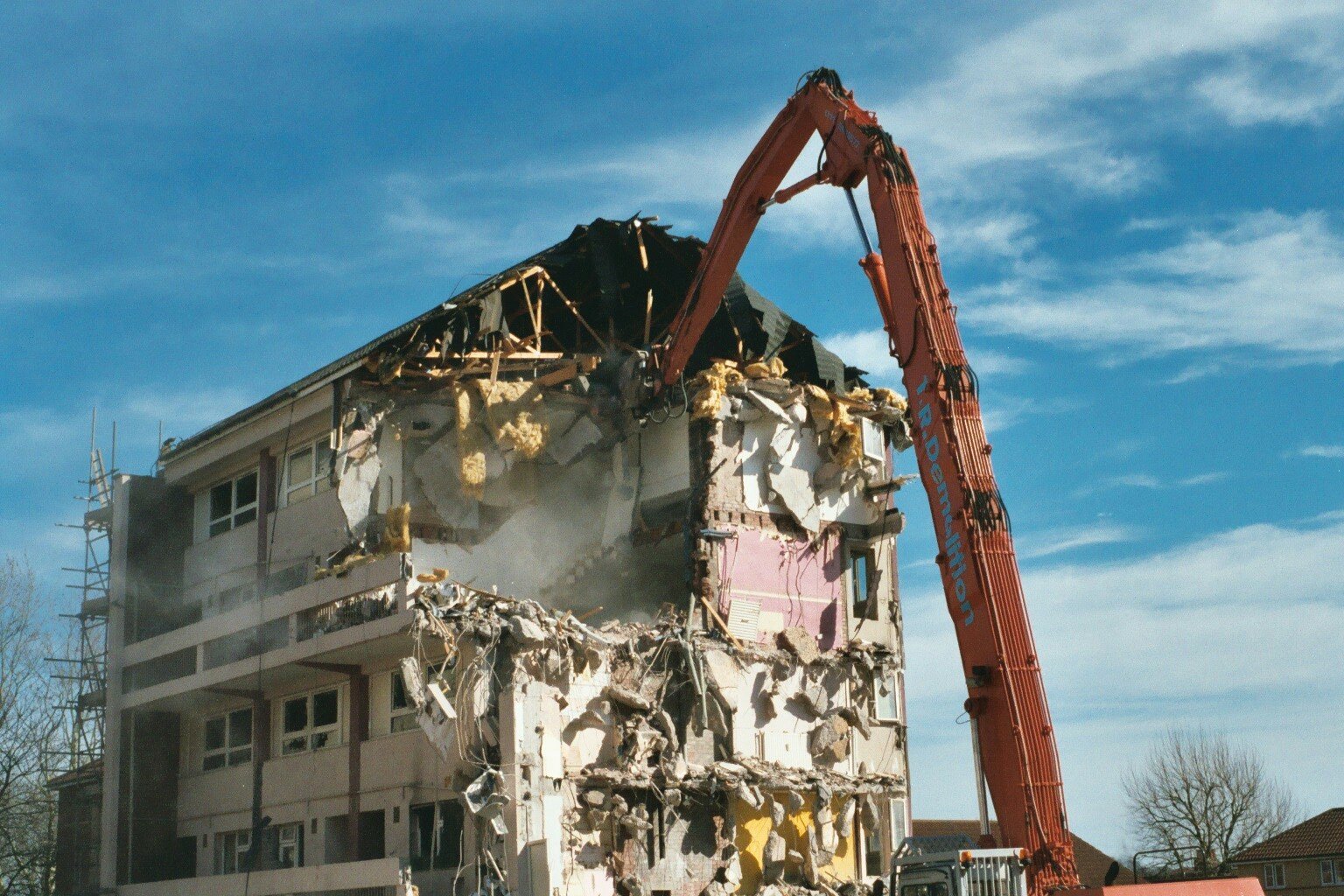
Another traditional demolition method is high reach arm (at the height of minimum 20 meters). This demolition type is commonly formed by an excavator or another base machine, an arm that consists of 3 sections or using a primary tool and telescopic boom attached to a crusher or similar base machines. This method is commonly used for steel, masonry, reinforced concrete and mixed materials.
Crane and ball is one of the most used and the oldest methods for demolishing a building. During the demolition process, the ball is swung or simply dropped into the structure. This method, nevertheless, isn’t suitable for every demolition application. It calls for an additional work to remove rebar in concrete structures. Also, for crane and ball demolition method, only highly experienced and skilled crane operators should be hired. Additionally, it creates a lot of noise, vibrations and dust.
Finally, there’s a selective demolition, also known as strip-out. This method is rather popular these days since it’s attractive to recycle and salvage materials. Selective demolition or recycling of metals, concrete, brick and wood is isn’t limited to removal of walls, ceiling, floor, interior and exterior components. The main purpose of selective demolition is to recover the maximum amount of reusable and recyclable materials in a cost-effective, safe procedure. Nevertheless, this method is time- and labor-consuming process that can lead to higher demolition costs for a light framed building.